UI
UX
Visual design
research
Reimagining EF’s tour product pages to inspire and convert leads
UI
UX
Visual design
research
Reimagining EF’s tour product pages to inspire and convert leads
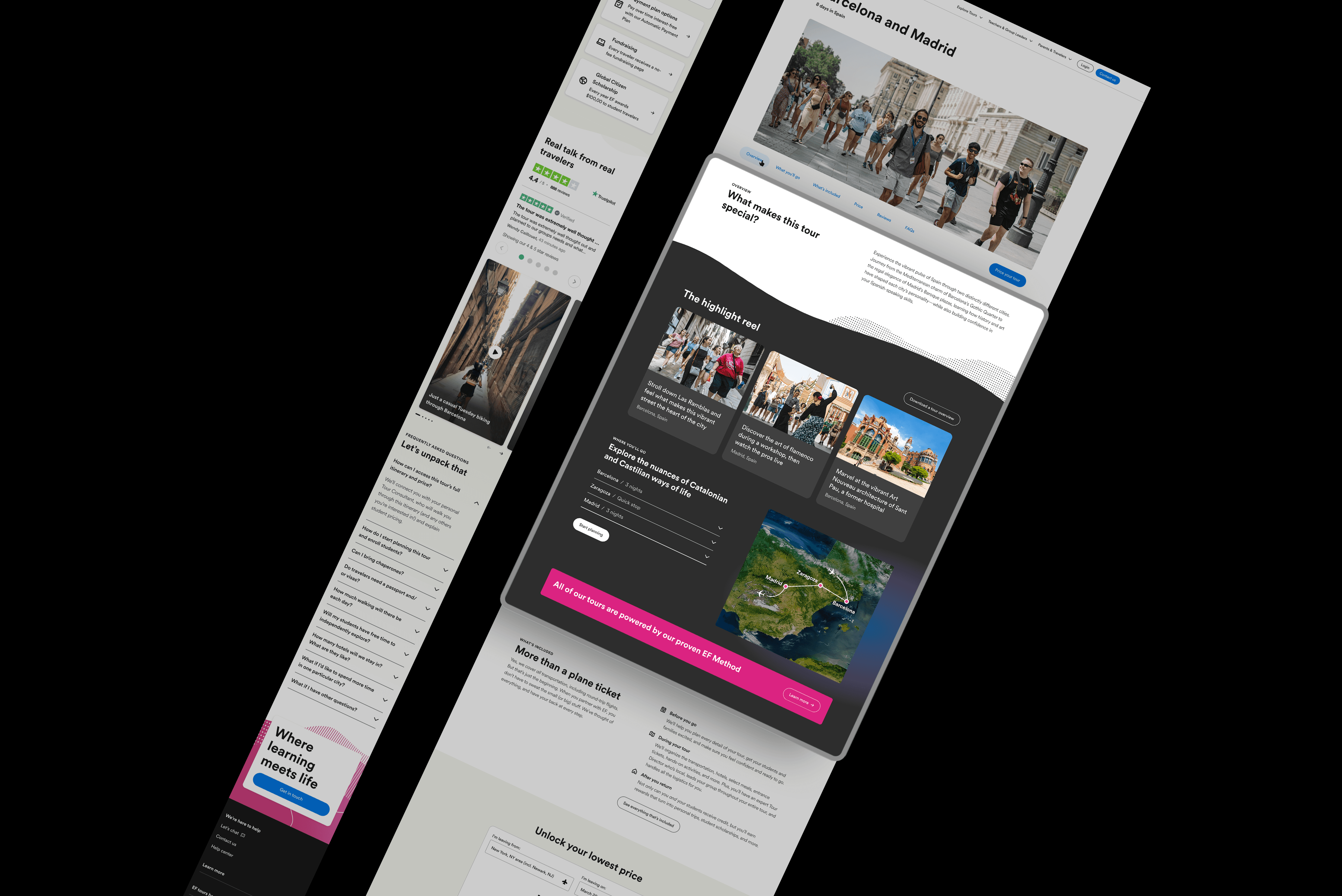
A redesign of EF Education's tour product pages to better inspire and convert teachers, using persona research, mobile usability testing, and a phased rollout to balance aspirational storytelling with the clarity needed to drive action.
PROBLEM
EF’s website was designed primarily for one audience, teachers, but didn’t account for the nuances in journey stage, persona type, or browsing behavior. New visitors exploring EF for the first time often lacked the clarity and confidence to take action.
With EF aiming to grow Group Leaders by 18% year over year, the public site needed to work harder to convert qualified leads, especially through its product pages, a key conversion point that hadn’t been updated in years.
Solution
I redesigned EF's tour product pages with a mobile-first, persona-driven approach that balances emotional inspiration with practical clarity: surfacing learning outcomes, transparent pricing, and detailed itineraries earlier in the page while using clearer CTAs and structured inclusions to build teacher confidence and drive conversions.
impact
50% median increase in conversion rate across MVP pages
~20% increase in scroll depth & higher content engagement rate
Primary CTA became top click on mobile over "Price"
Role
Senior Designer
Team
Copywriter, Marketing Strategy, Creative Directors, Web Content Manager
My Focus
Mobile first UX/UI design
User research
Prototyping
Cross-functional collaboration to balance business and user needs
Tools
Figma, Miro, FigJam, Claude, Lovable, Indesign, Photoshop, Illustrator
AI integration
Design ideation and iteration, sorting research insights
A redesign of EF Education's tour product pages to better inspire and convert teachers, using persona research, mobile usability testing, and a phased rollout to balance aspirational storytelling with the clarity needed to drive action.
PROBLEM
EF’s website was designed primarily for one audience, teachers, but didn’t account for the nuances in journey stage, persona type, or browsing behavior. New visitors exploring EF for the first time often lacked the clarity and confidence to take action.
With EF aiming to grow Group Leaders by 18% year over year, the public site needed to work harder to convert qualified leads, especially through its product pages, a key conversion point that hadn’t been updated in years.
Solution
I redesigned EF's tour product pages with a mobile-first, persona-driven approach that balances emotional inspiration with practical clarity: surfacing learning outcomes, transparent pricing, and detailed itineraries earlier in the page while using clearer CTAs and structured inclusions to build teacher confidence and drive conversions.
impact
50% median increase in conversion rate across MVP pages
~20% increase in scroll depth & higher content engagement rate
Primary CTA became top click on mobile over "Price"
Role
Senior Designer
Team
Copywriter, Marketing Strategy, Creative Directors, Web Content Manager
My Focus
Mobile first UX/UI design
User research
Prototyping
Cross-functional collaboration to balance business and user needs
Tools
Figma, Miro, FigJam, Claude, Lovable, Indesign, Photoshop, Illustrator
AI integration
Design ideation and iteration, sorting research insights
Before | After


Discover
Understanding the Audience
Discover
Understanding the Audience
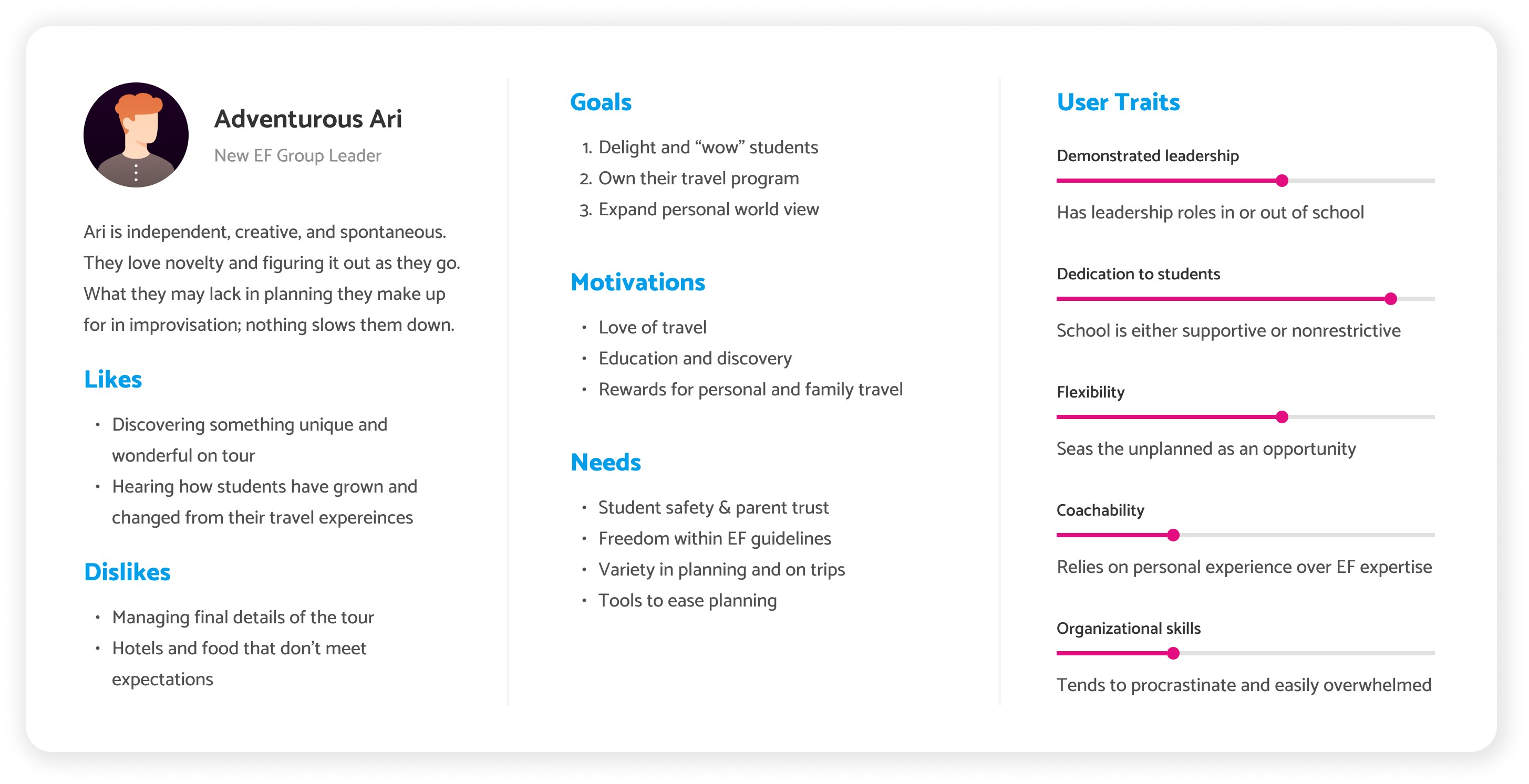
Our primary persona: Adventurous Ari
Ari is a new teacher exploring educational travel for the first time. She’s curious and idealistic, drawn to the impact travel can have on her students — but easily overwhelmed by the logistics.
Our primary persona: Adventurous Ari
Ari is a new teacher exploring educational travel for the first time. She’s curious and idealistic, drawn to the impact travel can have on her students — but easily overwhelmed by the logistics.
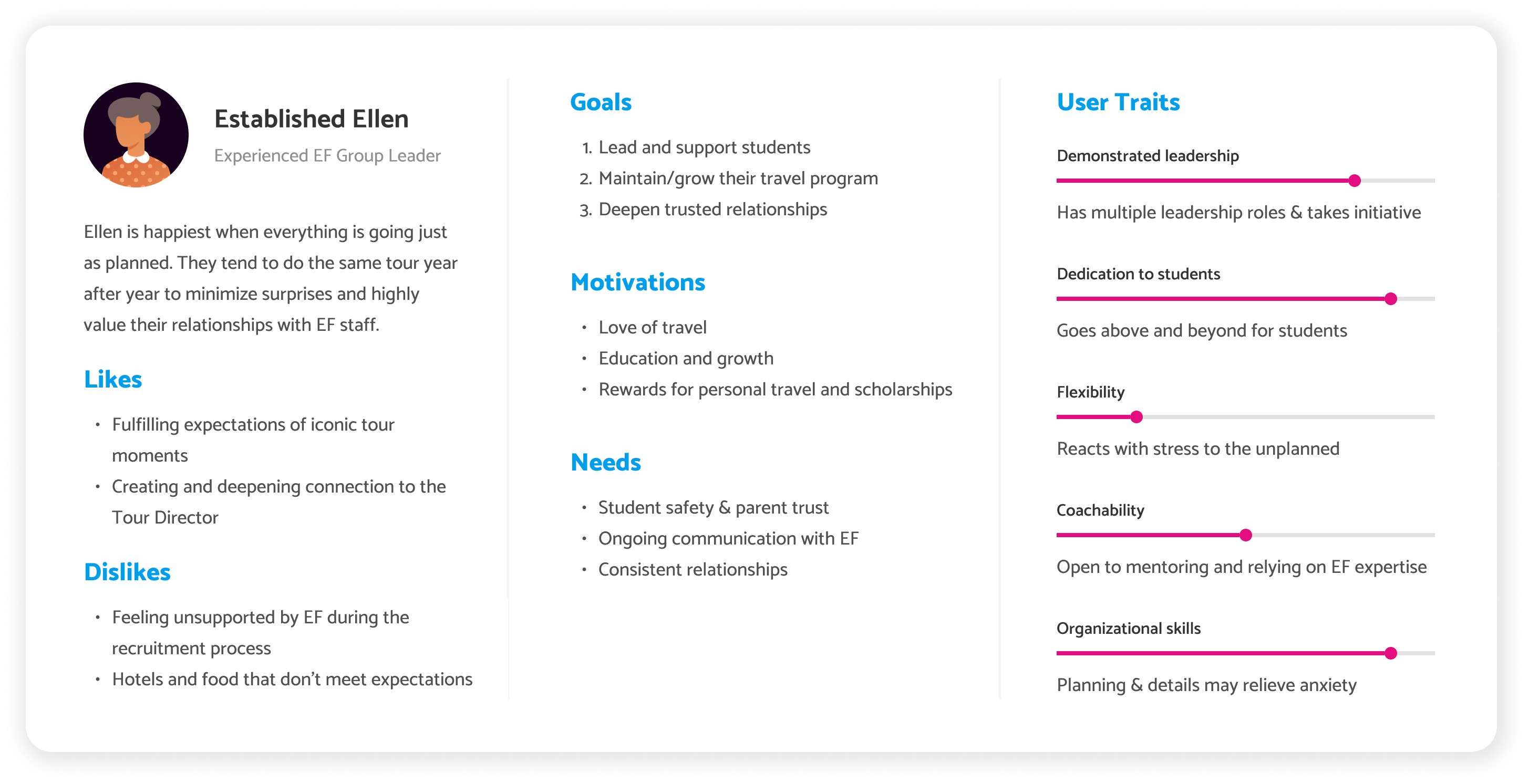
Our secondary persona: Established Ellen
An Experienced GL who loves the details and wants wants itineraries and logistics upfront.
Established Ellen also provides a design question for: how do we inspire dreamers without losing detail-lovers?
Our secondary persona: Established Ellen
An Experienced GL who loves the details and wants wants itineraries and logistics upfront.
Established Ellen also provides a design question for: how do we inspire dreamers without losing detail-lovers?
Define
How might we inspire teachers while giving them confidence EF will handle the details?
Teachers like Ari need an inspiring, clear, and confidence-building product page that balances dreaming and detail — showing that EF can make travel both exciting and manageable.
Primary goal:
Increase teacher conversion rate from 0.8% → 1.5%
Secondary goals:
Improve product page engagement metrics (scroll depth, time on page, CTA clicks)
Tailor content to match user intent and journey stage
Define
How might we inspire teachers while giving them confidence EF will handle the details?
Teachers like Ari need an inspiring, clear, and confidence-building product page that balances dreaming and detail — showing that EF can make travel both exciting and manageable.
Primary goal:
Increase teacher conversion rate from 0.8% → 1.5%
Secondary goals:
Improve product page engagement metrics (scroll depth, time on page, CTA clicks)
Tailor content to match user intent and journey stage
design
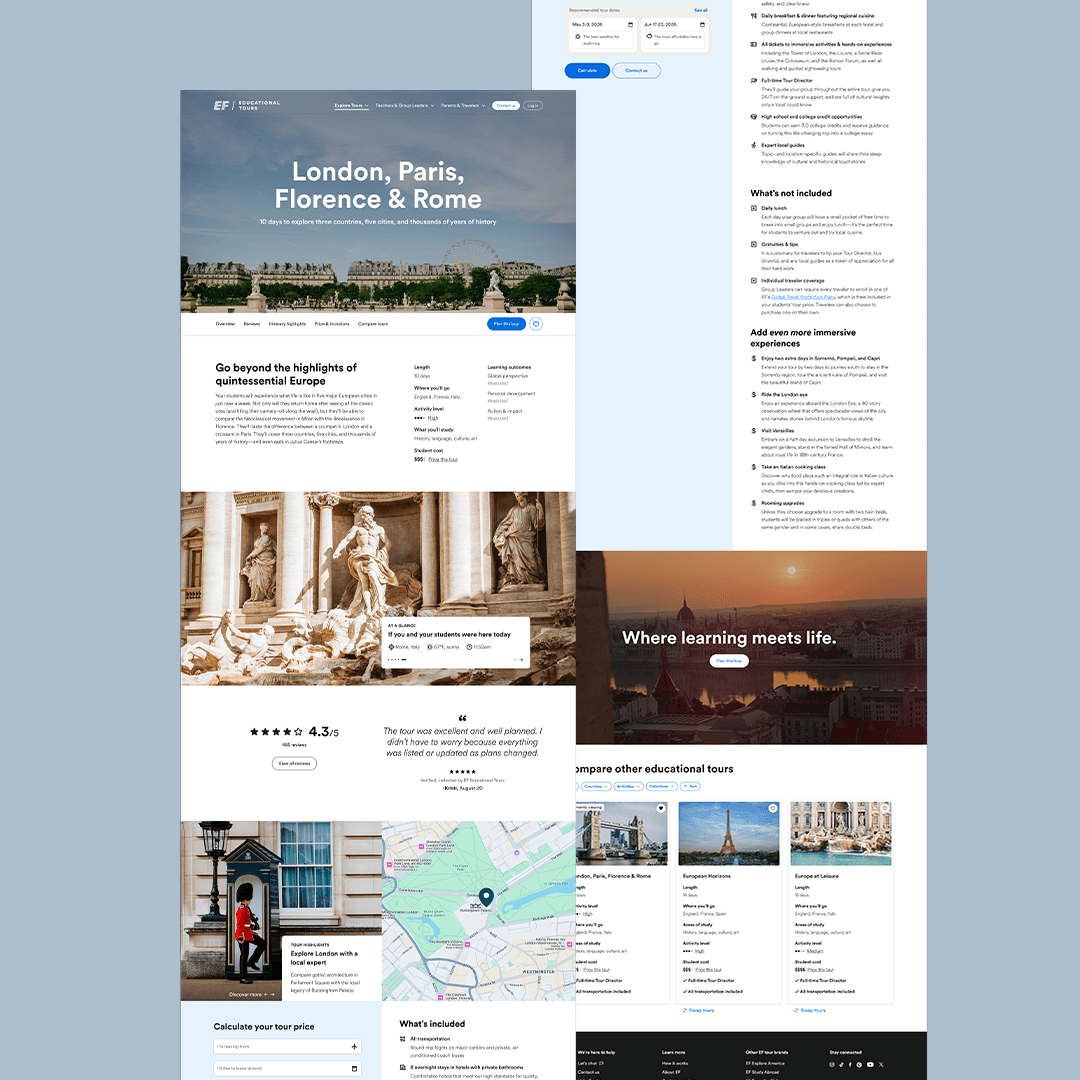
Creating high-fidelity desktop designs to present to senior leadership and illustrate EF’s long-term digital vision
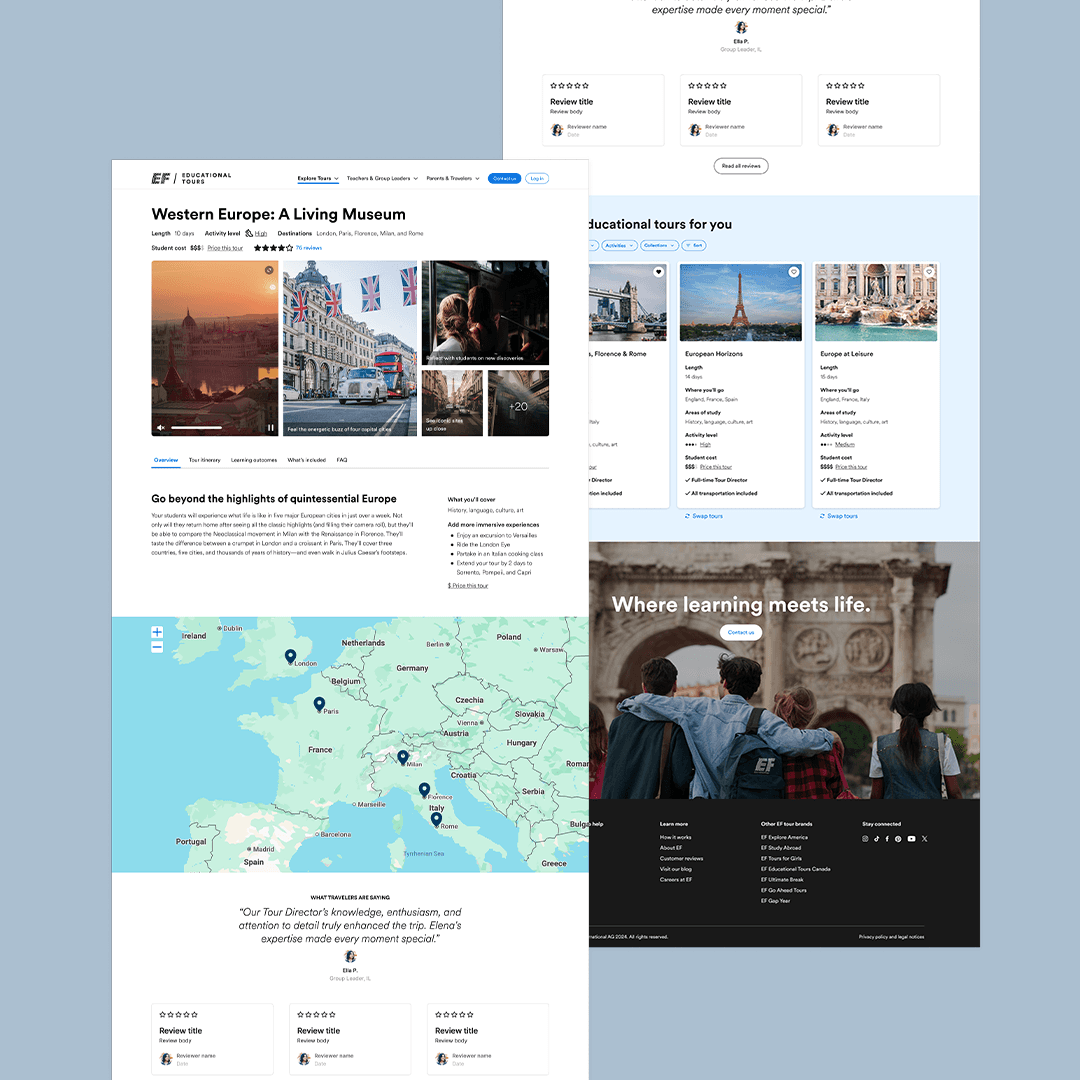
To validate different approaches and get stakeholder buy in on the design scope, we created two prototype directions, each testing how emotion, clarity, and hierarchy could drive conversion. We focused on creative strategy and storytelling potential for our primary audience (new Group Leaders).
design
Creating high-fidelity desktop designs to present to senior leadership and illustrate EF’s long-term digital vision
To validate different approaches and get stakeholder buy in on the design scope, we created two prototype directions, each testing how emotion, clarity, and hierarchy could drive conversion. We focused on creative strategy and storytelling potential for our primary audience (new Group Leaders).
1. Mosaic version
With this, destinations and imagery lead the narrative while information surfaced through modular tiles.
Pros: Visually inspiring, modern
Cons: Heavy on imagery, challenging for mobile
2. Immersive version
For this, learning outcomes are placed earlier in the scroll and there is a stronger balance between dreaming and grounding details.
Pros: Higher user comprehension, balanced tone
Cons: Itinerary section
Research
Understanding what content and interactions best build clarity, trust, and intent to convert
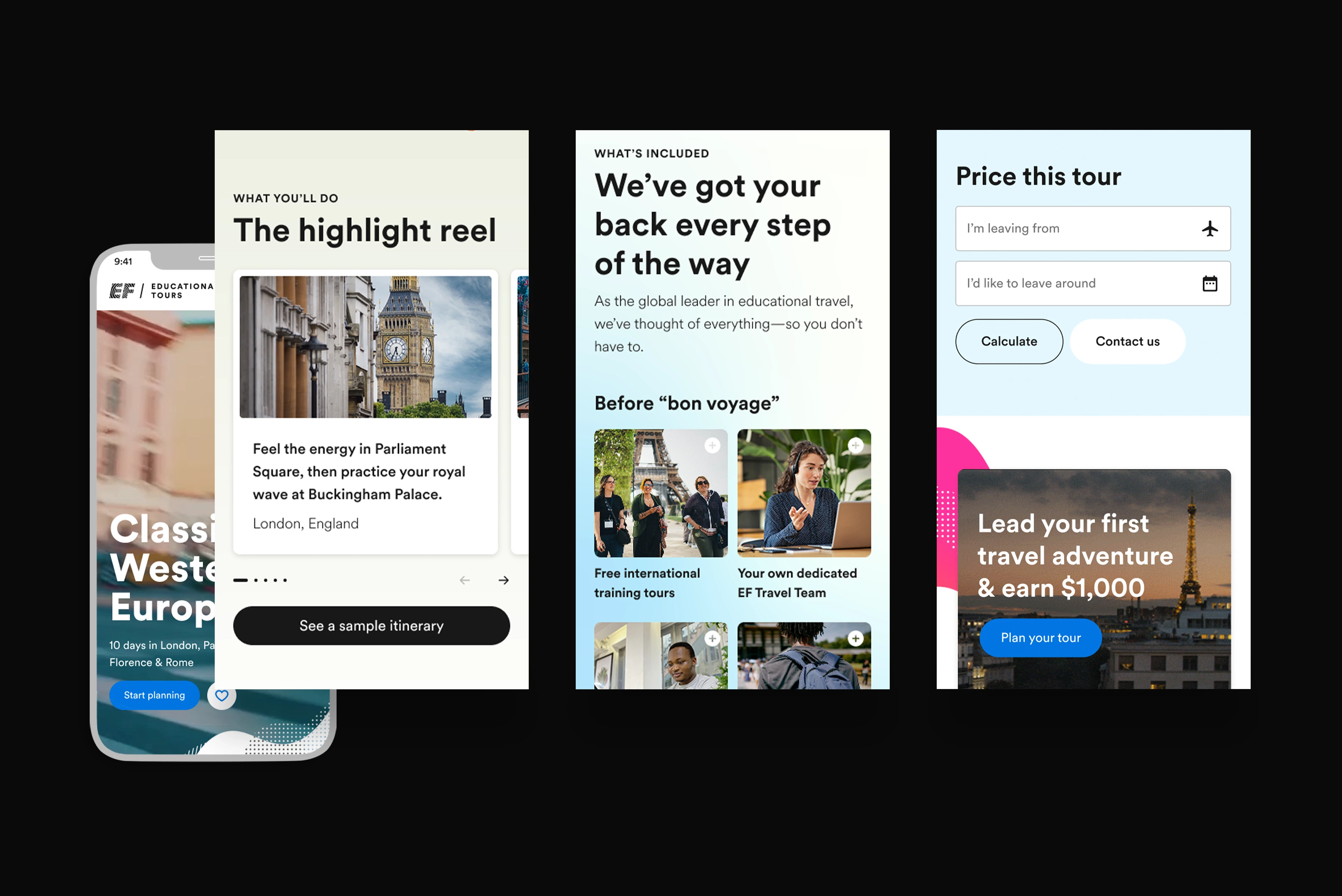
We tested two mobile prototypes with identical content, but distinct visual designs. The focus was on functionality, comprehension, and usefulness, not final visuals (which will evolve with EF’s upcoming brand refresh).
Research
Understanding what content and interactions best build clarity, trust, and intent to convert
We tested two mobile prototypes with identical content, but distinct visual designs. The focus was on functionality, comprehension, and usefulness, not final visuals (which will evolve with EF’s upcoming brand refresh).
Test type:
Remote, unmoderated usability testing on Userlytics
Duration:
Around 30 minutes per session
Participants:
24 teachers, both those familiar and unfamiliar with EF
Total Data:
525 minutes of video/audio recordings
Test type:
Remote, unmoderated usability testing on Userlytics
Duration:
Around 30 minutes per session
Participants:
24 teachers, both those familiar and unfamiliar with EF
Total Data:
525 minutes of video/audio recordings
Top user insights
Top user insights
Users expect a detailed, day-by-day itinerary—including travel times, accommodations, meals, and activities.
✅ Opportunity: Integrate map and itinerary; enable clickable or filterable daily views.
Users want clarity on what’s included, who it’s for (teachers vs. students), and how it connects to pricing.
✅ Opportunity: Create a detailed, structured inclusions section with expandable details and clear pricing context.
Explicit connections to curriculum standards, academic credit, and immersive learning is necessary.
✅ Opportunity: Use badges or icons to highlight academic tie-ins and create a dedicated educational value section.
Transparent pricing is needed before contacting us and clarification is needed on the next steps.
✅ Opportunity: Introduce dynamic pricing tools and pair costs directly with inclusions.
✅ Opportunity: Add microcopy to explain next steps (“We’ll reach out within 24 hours”), unify CTA language, and make actions more visible.
Users expect a detailed, day-by-day itinerary—including travel times, accommodations, meals, and activities.
✅ Opportunity: Integrate map and itinerary; enable clickable or filterable daily views.
Users want clarity on what’s included, who it’s for (teachers vs. students), and how it connects to pricing.
✅ Opportunity: Create a detailed, structured inclusions section with expandable details and clear pricing context.
Explicit connections to curriculum standards, academic credit, and immersive learning is necessary.
✅ Opportunity: Use badges or icons to highlight academic tie-ins and create a dedicated educational value section.
Transparent pricing is needed before contacting us and clarification is needed on the next steps.
✅ Opportunity: Introduce dynamic pricing tools and pair costs directly with inclusions.
✅ Opportunity: Add microcopy to explain next steps (“We’ll reach out within 24 hours”), unify CTA language, and make actions more visible.

Iteration & launch
A pilot rollout of the new design on five tour pages before expanding to the entire 250+ tour portfolio
Goals of the pilot:
Validate impact on lead conversion and engagement metrics
Gather behavioral data from real users
Ensure scalability and adaptability across all tours
Iteration & launch
A pilot rollout of the new design on five tour pages before expanding to the entire 250+ tour portfolio
Goals of the pilot:
Validate impact on lead conversion and engagement metrics
Gather behavioral data from real users
Ensure scalability and adaptability across all tours
Running live tests to see how the pagers were performing with real users
These tests included:
Adding a user sentiment survey to the pages to validate people were finding the information clear enough, with the option to give us more details about what they found unclear
Moving user generated content and tour highlights to see if they get more engagement
Testing copy on the itinerary button from Read a sample Itinerary to Download a Tour Overview to see if that reduces engagement with it and focused people more on the itinerary drop-downs
Moving the “What makes this tour special” section down to pair with inclusions
Running live tests to see how the pagers were performing with real users
These tests included:
Adding a user sentiment survey to the pages to validate people were finding the information clear enough, with the option to give us more details about what they found unclear
Moving user generated content and tour highlights to see if they get more engagement
Testing copy on the itinerary button from Read a sample Itinerary to Download a Tour Overview to see if that reduces engagement with it and focused people more on the itinerary drop-downs
Moving the “What makes this tour special” section down to pair with inclusions
Top performing
or second best performing tour in their category
50%
median increase in conversion rates on new tour pages
Primary CTA
became top click on mobile over “Price”
~20%
increase in scroll depth & higher engagement in content
Top performing
or second best performing tour in their category
50%
median increase in conversion rates on new tour pages
Primary CTA
became top click on mobile over “Price”
~20%
increase in scroll depth & higher engagement in content
Next steps
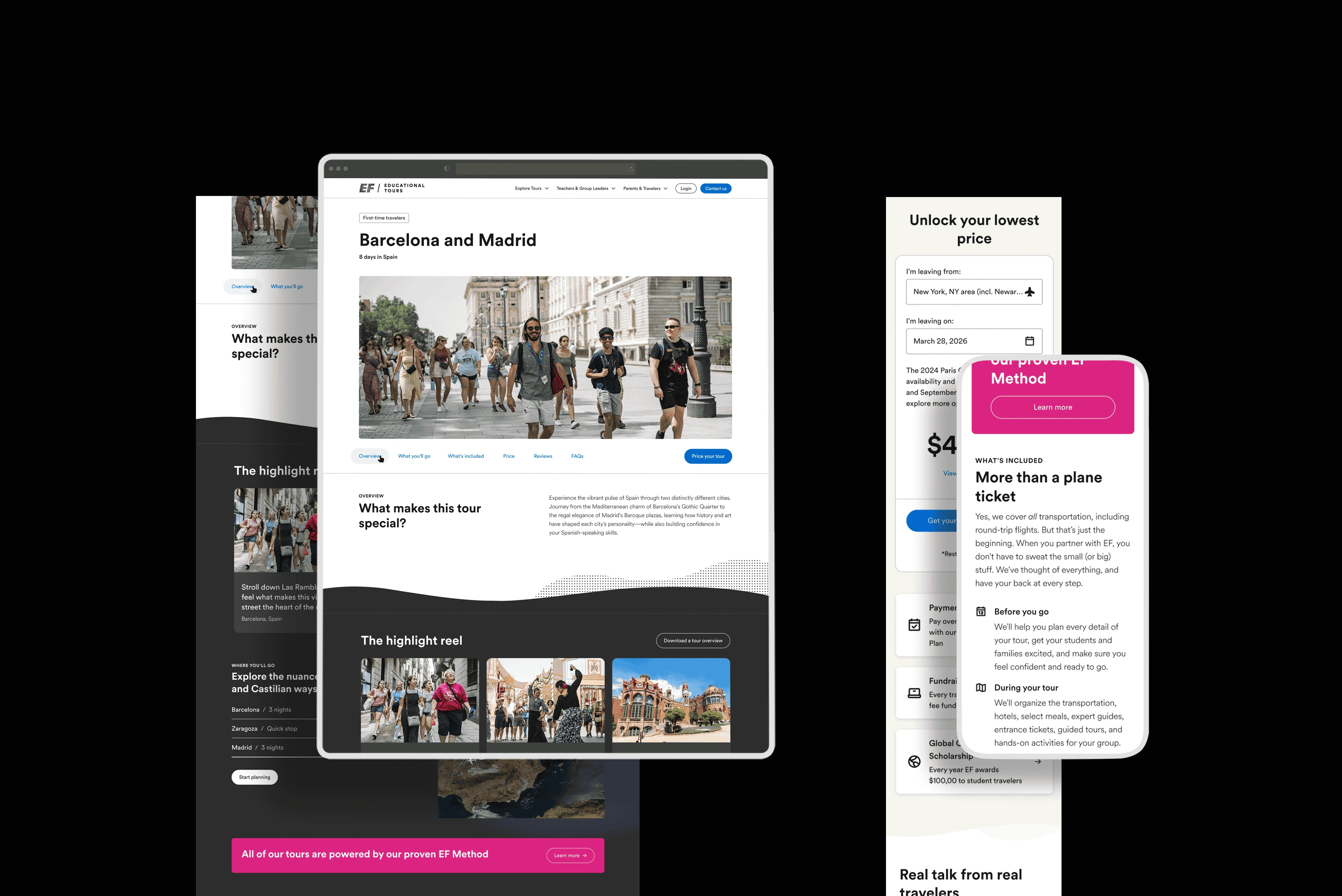
This redesign was more than a UI refresh—it was a strategic step towards personalization and storytelling on EF’s website.
The process of aligning stakeholders, testing with users, and designing for both “dreamers” and “detail-lovers” highlighted the balance between inspiration and clarity.
The new direction sets the stage for EF to evolve from a static tour catalog into a dynamic decision-support platform that grows with its audiences.
What comes next:
Refining designs from the user data we have collected as well as aligning to an ongoing brand refresh
Connecting our Product information management (PIM)
Update the itinerary and map to be more interactive
Next steps
This redesign was more than a UI refresh—it was a strategic step towards personalization and storytelling on EF’s website.
The process of aligning stakeholders, testing with users, and designing for both “dreamers” and “detail-lovers” highlighted the balance between inspiration and clarity.
The new direction sets the stage for EF to evolve from a static tour catalog into a dynamic decision-support platform that grows with its audiences.
What comes next:
Refining designs from the user data we have collected as well as aligning to an ongoing brand refresh
Connecting our Product information management (PIM)
Update the itinerary and map to be more interactive